Coilover Spring rates Suggestions

Chedman13

iS VIP
iS VIP
Location
Illinois
Car
2014 Mercedes-Benz GL63 4Matic
I am wondering what people are thinking about coilover spring rates.

1) Daily driver

2) Daily driver and occasional track

3) Daily driver and frequent track

From what I have seen, BC, KIDO, Megan, ebay -- all have a Front spring rate of 8 kg and a rear of 12 kg.

I don't want this discussion to be about the dampening of the piston, just springs.

These are my thoughts:

1) Daily driver = Front 6kg rear 8 kg
2) Daily driver + occasional track = Front 8kg rear 12kg
3) Daily driver + frequent track = Front 10kg rear 14 kg

My main focus (selfishly) is #1. I was thinking getting a custom 4kg front and 6kg rear, but I that would be a too bouncy ride, even with the dampening set at very firm. Especially since our FX's are so heavy. Probably have a lot of nose dive at quick stops.
 
Ed....

Just seen this post.. No more PM's about this.. LOL..

Mod on.

=)

So Humberto originally had 8KG front and 12KG rear (standard) on his Megan's. He swapped the rears for 18KG to get rid of any bounce in the rear.

So right now his preferred setup is 8KG front and 18KG rear.
 
it'd be a little hard for me to speculate as to exact spring rates & suitability of each as I haven't completed & fully tested my coil overs yet, engine came out before that ever happened, but I can still give some input...

first of all, the reason the rear rate is higher than the front is because of the different ratios of leverage placed upon each, from general observance it seems that the rear require aprox 25% stiffer than the front according to what the aftermarket are spec'ing, BUT, from my own experience I have found that the handling will improve even more by raising the rear rate to above 25% over the front, in some cases well above. I have found that increasing the rear spring rate really improves the fx's horrible tendency to "walk sideways" in the bumpy stuff in turns in the rear, so I guess I'd keep that in mind. my handling went for good to great by just increasing my rear spring rate by ~40% over what it was originally

another thing to keep in mind is that increasing the spring rate itself will help performance, but sacrifice comfort as the trade off... well there is another part to the equation & that is sway bars... I think if the sway bar rate could be increased INSTEAD OF the spring rate, this would also lend similar benefits to handling without as severely impacting comfort as much as raising the spring rates will. the fx is heavy & a higher center of gravity, increasing stiffness goes a long way towards reducing body roll, but body roll could also be kept in check with increasing the anti sway bars & if I was looking to do an "ideal" street setup I'd def look heavily into increasing & even providing adjust ability of the sway bars... adding ~25% stiffness to the rear sway bar of the fx alone would result in much improved handling without sacrificing too much comfort all other things being equal...

as far as your pillow ball vs rubber mounts question, again, this is a direct trade off of comfort vs performance, pillow balls will not deflect & will not absorb, increasing the direct link of dampener to movement which does increase there performance & help maintain suspension geometry in theory, but the flip side is this direct link is also going to add harshness & at least some noise to the ride... becomes a matter of priority... personally I would rather not trade off comfort for only marginal & unmeasurable gains on a street car, so I built my coilovers with the stock rubber mounts.... stuff like pillow balls, solid motor & tranny & dif mounts, etc, are all cool on paper but in the real world to me anyway, the trade off is not worth the insignificant improvement, your giving up too much for too little to gain & in the end some guys that overdue what they see all the racer dudes doing, wind up ruining there ride quality for no good reason... to me if your looking for the benefit a pillow ball is going to have over rubber mounts then you should also look to replace your suspension bushings, as they will also deflect quite a bit, more so even that the strut mount... to me I wouldn't consider pillow ball mount being a benefit or even necessary unless the control arm bushings have already been addressed, but at that point were looking at a harsh ride.

far as your mono vs inverted vs external mono, obviously the "best" would be an external reservoir, inverted mono tube, but, were talking exotic here, the benefit of reduced unsprung weight may be hard to justify vs the extreme costs involved in such a setup, on a street car I'd say that a quality shock is the primary concern... quality as in longevity... any company can produce a shock that performs out of the box, but a race car may do less than 1k miles a year & then service the suspension, where a street car needs to have shocks that will last for 30-40,50k miles... for that I'd look to the leaders if at all possible, think KYB, Koni, Bilstien, etc... I'd say that the longevity of dampening performance will be the big difference between an unknown china manufacturer & a giant in the industry such as the ones mentioned. these big manufacturers have the resources & budget to do the R&D & materials analysis & testing, where all the smaller china manufacturers can do is what they do best, try & copy a proven design... most times the copy is NOT as good as the original by a long shot... personally I'd want koni or bilstien if at all possible which is why I built my coilovers based on koni touring car inserts...

dual spring rates & progressive springs can be a great thing but will require some R&D & trial & error too, if your not opposed to swapping springs several times in the name of testing then may be better to keep it more simple, but yeah, def a nice place to play if your so inclined...

aluminum vs steel strut mounts??? either would be fine, aluminum will be more common on pillows because of ease of machining, I wouldn't be too critical of either honestly but pillow will most likely be aluminum & rubber will be steel usually...

far as other questions, dust covers are always a good idea to protect the piston which increases service life, camber/caster plates are not usable by our rear suspension design, only front & then probably only going to be enough room for this with pillow which I've already stated my view there... I wouldn't be so concerned about adjustabilty in the mount, camber bolts alone will be more than you'll need up front I'd say & your not going to be changing your alignment on the fly for differing tracks & track conditions, which is what that adjustabilty is really for, again this is another case of street guys copying racers for no real reason... spring preload will be dependent on strut design & fixed cup with locking collar sounds good if you can get it, good luck with it man :)
 
Last edited:
Some background -- I've been doing some research on the "perfect" coilover setup and started this post and got a little carried away and PMed some members... For those that have read my BBK research, I tend to over-research before I put any money down.

Thanks Turbo -- I've been reading your threads on suspension and figured you could chime in. I see you started with a 400 lb/inch spring (or 7.2 kg) (after reading 13 or so pages I found a spec!:rofl:) as your baseline.

That is in line with the 8kg fronts the after market crowd has been building. 12kg rear as the after markets have done, is 50% stiffer than the fronts. And even so, reports on the field are this is still not stiff enough. 225% stiffer than fronts is what Humberto did at 18kg.

I think my end goal will be 8kg front and 14-16kg rear as a compromise from what I've heard/seen. When I think of quality ride, it's more so on the front suspension than the rear. But if the rear walks sideways as you said over bumps as people have experienced on OEM springs, H&R's, Eibach's, BC's and Megan's -- I think at least 14kg is in session here.

The dual linear spring setup with different rates is tricky, but I just might have to try it out. There seems to be enough length in the tube setup to have a dual spring. I was researching the math on what a, let's say 4kg and 8kg dual spring acts like a progressive spring. But even two 8 kg springs will be softer than a single 8kg spring I think. I'm going to have to work with an engineer to figure out what lengths and spring rates to get.

True, I'll never see or use the benefit of a external or inverted -- maybe I'll just get external just for kicks =) Yeah, my KYB's actually lasted 100k and no leaks.

I'll see if I can get rubber mounts, if not, at the least, pillow ball with rubber inserts. The BC crowd seems fine so far with the pillow ball mounts.

Man you know your stuff, yeah the pillow balls were aluminum mounts and the rubber were steel I believe. Didn't know it went hand in hand.

Back to the drawing board.
 
keep in mind that bert has widened his track width, this increases the leverage on the spring... this is a contributing factor also as to why he needed so much additional spring rate in the rear on his, don't assume that yours will be the same... an analogy to his situation would be a seesaw, imagine 2 sides equal weight/equal length, will be equal force each side, now go & extend one side, you'll see that the opposing side would need more "force" to balance the seesaw again, same as bert needed more spring rate... his extra wide ass is a contributing factor there :)

also, you say your kybs lasted 100k without leaks but this is not true... yeah, there were no external leaks, but shocks deteriorate with internal leakage, or more precisely internal leakage past the seal(s), THIS is where the difference is between good shocks & not so good shocks...
 
Last edited:
keep in mind that bert has widened his track width, this increases the leverage on the spring... this is a contributing factor also as to why he needed so much additional spring rate in the rear on his, don't assume that yours will be the same... an analogy to his situation would be a seesaw, imagine 2 sides equal weight/equal length, will be equal force each side, now go & extend one side, you'll see that the opposing side would need more "force" to balance the seesaw again, same as bert needed more spring rate... his extra wide ass is a contributing factor there :)

Haha.

Didn't even think of that. Always liked how you explain things in layman's terms.

Kieran said in your thread:
Key there is appropriate struts/shocks as doing stiff springs with stock shocks would just ruin them in no time. I don't know if there is anyone out there making anything though that could handle decent spring rates. You'd probably be looking at rates of over 1000 pounds. I'm thinking of doing 800 front and 1000 rear on my 2800 pounds SE-R. A 4700 pound (I think) FX would likely want at least 1000f/1200r to handle decently. To maybe compromise to get decent driveability maybe back it off to 800/1000 or even 600/800?

Since I'm dealing with kg/mm instead of lb/in, converting those (0.0178579673228346):
Decent for track (estimate)
front: 1000 lb/in = 18.86 kg/mm
rear: 1200 lb/in = 21.43 kg/mm

Street
front: 800 lb/in = 14.29 kg/mm
rear: 1000 lb/in = 18.86 kg/mm

Street (even softer)
front: 600 lb/in = 10.72 kg/mm
rear: 800 lb/in = 14.29 kg/mm

I'm leaning towards 8-10kg front and 12-14kg rear now...
 
Last edited:
Great thread BTW and good information. I am a #2 driver (yes, at times I am a s**t driver) BUT the street/occasional track at 8-12/14 sounds correct. I am still very happy with the BC's BUT that's not saying they couldn't be even better. Come on Ed make them better.....
 
well yeah, what kierian said does hold true when it comes to the stock struts being used with very stiff springs, but the adjustable dampening of the coilovers kinda solves this to a certain extent, only issue there may be if there not valved for enough dampening at the end of adjustment, if that becomes the case then the shock would need to be re-valved... this is actually something that companies like bilstien & koni actually do to there own stuff if you send it to them, you could send them back to them & they'll re-valve it for a nominal fee to suit your use... I'm hoping that the adjustment range of compression & rebound are satisfactory in my setup but if not, there is always the option of sending them to koni to be re-valved...

the 1k# fnt, 1.2k# rear kerian suggests (rears should be a lot more)would be ok for a track car but on the street it would ride like a jackhammer... you ever drive a track prepped car? the stiffer the suspension the higher the frequency of oscillation, jack hammer about sums it up :) don't overdo it unless it is with a progressive dual rate design, which can be great but again, a lot more trial & error. again I'm going to say too that to improve the handling of a street fx without sacrificing ride quality too much you should put effort into anti sway bars, there is a lot of untapped potential there if your really looking to build the ultimate setup of comfort and handling...

oh, & btw, when I choose my 400# I did that blindly, there were no aftermarkets yet & no real base line to go buy so I just did the best I could to calculate what I thought should be a good range and place to start & I choose one end of the range I considered to be probable... I ordered 400# but with the intension's of that just being the starting point, fully expected to also get several more springs in 50# increments up to ~600# & compare & test each to find the sweet spot... luckily for you there is now a whole lot more data available by looking at what the aftermarkets have used, back then there were none...

---------- Post added at 07:49 PM ---------- Previous post was at 07:46 PM ----------

oh, & you forgot the #4 driver, drive's it like it's stolen:wink:
 
Man, can I get some cliff notes please, after dealing with patients and reading files and dictating reports all day I want summaries not novels please :smug::tongue (2):

But nonetheless, great info :tup:
 
To make things interesting...

Eibach SUV PRO-KIT # 6366.540 which reviews state they are firmer than OEM and H&R’s are:
Front: 171 lb/in = 3.05 kg/mm (linear)
Rear: 361 lb/in to 573 lb/in = 6.44 kg/mm to 10.23 kg/mm (progressive)

Just to add some other data while I have it: Front Eibach = 344.8 mm (13.5 in) and Rear Eibach = 326.8 mm (12.8 in)

H&R’s are supposedly progressive in front and rear and are softer than Eibach and OEM (on the low end), but at the high end, firmer than OEM, but not Eibach (all from my reading of reviews). I can’t confirm any of this because a H&R rep told me they don’t and won’t release spring rates to the public. It’s equivalent to the secret recipe of Coca Cola apparently.

So this has me a little thrown off, I had to ask the Eibach person twice to confirm the front spring rate. He checked twice as well. H&R’s should be in the ball park of Eibach (my guess) so I’m going to use Eibach’s, BC’s and Megan’s as my test subjects for research.

The end game is getting the firmest spring rate, that is tolerable and dare I say comfortable for daily driving. I’m surprised Eibach didn’t go progressive on front and rear, and also how soft they are. Since I have no complaints from BC or Megan owners on the front 8kg rear 12 kg setup, that should be, to my thoughts the minimum or floor spring rate. Granted the front is 5kg firmer than Eibach, I don’t think I want to go any firmer. The rears, depending on the setup and what you haul, the maximum I’ll say here is 18 kg that Humberto is running for daily driving.

Having a dual spring setup for the front does make this more interesting, as the combined spring rate is, where I’ll denote R for spring rate, c for combined, m for main and h for helper: 1/Rc = 1/Rm + 1/Rh. Engineers, did I get that right? So let’s just say a 2 inch helper spring at 3 kg/mm and a 10 inch main spring at 12 kg/mm. That gives a combined spring rate of only 2.4 kg/mm! But being progressive, the 2 inch helper will compress on daily driving bumps, but after it compresses fully, the 10 inch main spring will kick in and be a very firm 12 kg/mm. Hence a way to have a progressive spring with two linear springs. This might be the best of both worlds, but I will have to work with an engineer to figure out spring rates and length to dial this in.

I could go for a single spring setup on the front, but just want to try something different.

Can anyone help explain spring rates and control in rain/snow – or if there is any correlation? Harder spring rate = better on track, but what about normal driving conditions? I keep reading that some people want softer spring rates so it handles better in rain and snow – is there any reasoning behind this?

Pierce, cliff notes will be at the end of this thread – once this is all figured out (at least to some degree).
 
What would be the benefit of this dual linear rate spring system over a single progressive rate spring? You're going to have the springs fabricated either way, right?

Posted from my BlackBerry using BerryBlab
 
I would recommend getting your hands on a few suspension & handling books,... there is a lot to the equation & each piece of the puzzle directly relates to the others, there is just too much to put in a post or 2, if you don't understand everything going on then just knowing one piece of the puzzle will cause incorrect assumptions & you will not have the whole picture, def a case of a little knowledge being a dangerous thing... if you really wanna do the research then read a few whole books on the subject would be my best advice..., everything that I have really desired to learn I have read every book on the subject I could find, after reading a few different books on the same subject you'll start to really learn what it is you want to learn....
 
Last edited:
...

So this has me a little thrown off, I had to ask the Eibach person twice to confirm the front spring rate. He checked twice as well. H&R’s should be in the ball park of Eibach (my guess) so I’m going to use Eibach’s, BC’s and Megan’s as my test subjects for research.
....

Consider two linear rate springs, "Sa" and "Sb". Sa has a rate of 5kg/mm and a length of 100mm. Sb has a rate of 10kg/mm and a length of 60mm. A 400kg weight would compress both springs down to 20mm (giving the same "stance") but one is still twice as stiff as the other.

...

Having a dual spring setup for the front does make this more interesting, as the combined spring rate is, where I’ll denote R for spring rate, c for combined, m for main and h for helper: 1/Rc = 1/Rm + 1/Rh. Engineers, did I get that right? So let’s just say a 2 inch helper spring at 3 kg/mm and a 10 inch main spring at 12 kg/mm. That gives a combined spring rate of only 2.4 kg/mm! But being progressive, the 2 inch helper will compress on daily driving bumps, but after it compresses fully, the 10 inch main spring will kick in and be a very firm 12 kg/mm. Hence a way to have a progressive spring with two linear springs. This might be the best of both worlds, but I will have to work with an engineer to figure out spring rates and length to dial this in.

...

Dual linear springs in series do not behave exactly like progressive rate springs. They are somewhat similar in that at some point, the rate can change if one of the two springs reaches it's compression limit before the other, but it's a much more sudden change of resistance than what is seen in a progressive spring. With a dual linear spring series configuration, both springs are working together all the time, and their combined rate is still linear (again, up to the point at which one spring is fully compressed). Your equation is right for the combined spring rate, but rather than constantly (and smoothly) increasing it's resistance in proportion to the load like a progressive system, your dual spring system would remain 2.4kg/mm until the weaker spring reaches it's compression limit, at which time the rate would suddenly jump straight to 12kg/mm. I think it's safe to assume you would absolutely feel this "crossover point", and the effects on handling in extreme situations would be severe. Imagine taking a hard and fast corner on a track, but rather than smooth predictable body roll, you have an 80's Cadillac for the first 5 degrees and a 350Z from there on out. At the very least it would take "some getting used to"...
 
I guess this project came to a dead end. Never heard back from my contact in Taiwan:embarrassed:

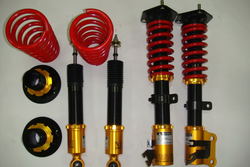
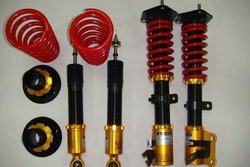
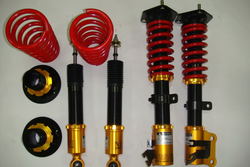
Here was an off-the-shelf kit he had for the 1st generation FX though:

FX35-1.jpg
 

Attachments

  • FX35-1.jpg
    FX35-1.jpg
    93.7 KB · Views: 67
  • FX35-1.jpg
    FX35-1.jpg
    93.7 KB · Views: 68
I'm back at this... trying to find the sweet spot. Thinking 10 kg front and 14 kg rear.

I need a less rebound distance to go lower, as I will rub due to the tires being so wide and very aggressive offset. So bumping up the "standard" 8 kg front to 10 kg. The "standard" rear is 12 kg, but Turbocad, Kieran and Humberto have all in harmony mention a larger difference from the front will be better, so this is 40% stiffer than the front at 14 kg.

This setup should allow me to go as low as H&R's without rub, have amazing ride quality on smooth roads -- with more oscillation on rough roads. Again, will depend a lot of the valving of the shocks too.

Car is so heavy, the 10 kg / 14 kg doesn't worry me at all. Time will tell.

Wondering if the car will "float like a Cadillac and sting like a Bimmer." Those that know the quote, you probably have kids and watched this movie 1,000 times.
 
Back
Top